Questions about cenotes
Everything you need to know before diving in the cenotes of the Riviera Maya.
Can I dive in the cenotes with a recreational certification?
Yes. There are more than 15 cavern routes that can be dived with a recreational certification, starting from Open Water, using the same single-tank configuration you would use for ocean diving.
What is the difference between a cavern and a cave?
A cavern is an overhead environment where natural daylight is still visible. In Mexico, cavern lines are installed so the exit is never more than 60 linear meters away, making these dives safe when the chosen sites match the diver’s certification level, whether Open Water or Advanced.
How do I choose cavern dives according to my level?
Leave that to us. When you contact Scuba Alux, the first thing we do is ask about your certification level, previous experience and personal preferences. Based on that, and with the help of cenote videos, we design the dive plan that best fits you so you can enjoy the experience safely and fully.
What is the water temperature in the cenotes?
The water in the cenotes stays between 25 °C and 26 °C year-round. A 5 mm wetsuit is usually enough to stay comfortable during one-hour dives. If you tend to get cold easily, you can add a hood or thermal layer.
I’ve heard all cenotes are the same. Is that true?
Not at all. Every cenote is completely different. If you decide to spend several days cenote diving, get ready for a different underwater experience every day. That variety is one of the biggest attractions of cenote diving.
If cenotes have little marine life, are they still worth diving?
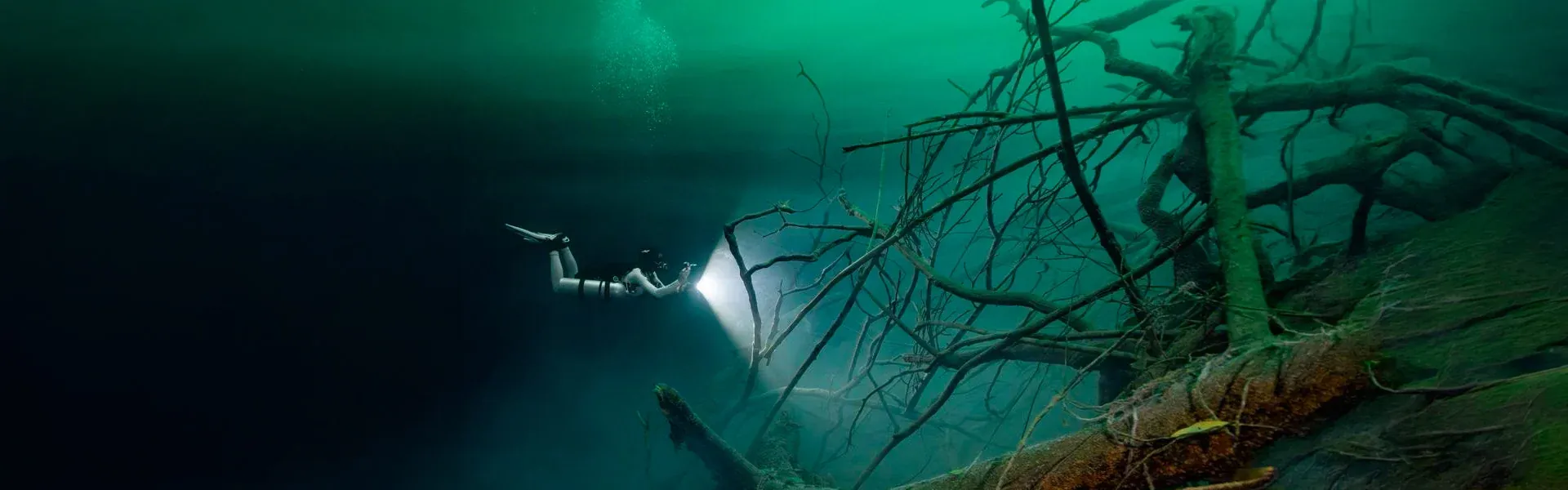
It is true that wildlife is not the main attraction of the cenotes, but they do have a delicate ecosystem with freshwater turtles, different species of fish, crabs and occasionally even crocodiles. Beyond wildlife, cenotes offer hydrogen sulfide clouds, dramatic light beams, crystal-clear water and limestone formations such as stalactites and stalagmites, making Mexico an incredible diving destination.
Are two dives included when I book a cenote diving experience with Scuba Alux?
Yes. We usually do two dives in one morning, and we can even organize a triple-tank day if you prefer. Some cenotes, such as Chac Mool and Dos Ojos, allow two completely different dives without changing location, while other combinations include moving to a different cenote between dives. Whatever the plan, we will pick you up at your hotel and take you back at the end of the experience. You only need to enjoy the dives.
Questions about Cozumel
Logistics, comparisons and everything you need to know about diving on the island.
What is the difference between diving Cozumel by speedboat or by ferry?
Cozumel is a small island located off the coast of Playa del Carmen, and both locations are connected by ferries running daily, roughly every hour in both directions.
If, beyond diving, you want to visit Cozumel, the ferry is the best option. We will give you all the instructions to cross from Playa del Carmen and meet you directly at the dive center in Cozumel. After the dives, we are usually back around 1 pm, so you can stay on the island, return to Playa whenever you like or even spend the night in Cozumel if you plan several consecutive reef diving days.
If you are not interested in visiting the island, the express speedboat is the easiest option. We leave from Playa del Carmen early in the morning, head to the Cozumel dive sites, do two dives with the proper surface interval and return to Playa del Carmen around midday.
In both options, the dive sites are the same and are chosen according to sea conditions. Only the logistics change.
What is the difference between diving in Playa del Carmen and Cozumel?
Cozumel is known for its coral reefs, strong currents on most days and incredible visibility that turns everything blue as soon as you enter the water.
Playa del Carmen has two reef areas: a closer, shallower reef between 6 and 12 meters, ideal for first diving experiences, and a deeper area farther offshore, beyond 18 meters, with beautiful dive sites where the coral is not as impressive as in Cozumel but there is still plenty of life.
Although currents are usually stronger in Cozumel, Playa del Carmen can also have moderate to strong current days. For that reason, all dives are drift dives, with the boat picking divers up at the end point.
Questions about Playa del Carmen
The most common questions about diving on our coast.
What is the difference between diving Cozumel by speedboat or by ferry?
Cozumel is a small island located off the coast of Playa del Carmen, and both locations are connected by ferries running daily, roughly every hour in both directions.
If, beyond diving, you want to visit Cozumel, the ferry is the best option. We will give you all the instructions to cross from Playa del Carmen and meet you directly at the dive center in Cozumel. After the dives, we are usually back around 1 pm.
If you are not interested in visiting the island, the express speedboat is the best option. We leave from Playa del Carmen early in the morning, head to the Cozumel dive sites for two dives and return around midday. In both options, the dive sites are the same; only the logistics change.
What is the difference between diving in Playa del Carmen and Cozumel?
Cozumel is known for its coral reefs, strong currents on most days and incredible visibility that turns everything blue as soon as you enter the water.
Playa del Carmen has two reef areas: a closer, shallower reef between 6 and 12 meters, ideal for first diving experiences, and a deeper area farther offshore, beyond 18 meters. All dives are drift dives, with the boat picking divers up at the end point.
Questions about technical courses
About technical diving, caves and advanced training.
What is the difference between diving in Playa del Carmen and Cozumel?
Cozumel is known for its coral reefs, strong currents on most days and incredible visibility that turns everything blue as soon as you enter the water.
Playa del Carmen has two reef areas: a closer, shallower reef between 6 and 12 meters, ideal for first diving experiences, and a deeper area farther offshore, beyond 18 meters, with beautiful dive sites where the coral is not as impressive as in Cozumel but there is still plenty of life.
Although currents are usually stronger in Cozumel, Playa del Carmen can also have moderate to strong current days. For that reason, all dives are drift dives, with the boat picking divers up at the end point.
Can we do a night dive?
Absolutely. Night dives in the Caribbean Sea are varied and very different from daytime dives. We only need a minimum of 4 participants to organize the trip, either off Playa del Carmen or in Cozumel.
General questions
About Scuba Alux, bookings and practical travel details.
Do I need dive insurance?
We strongly recommend having valid dive insurance that covers recreational diving for the activities you book. At Scuba Alux, we can offer the option to purchase additional insurance; the conditions are provided at the time of booking.
What is the cancellation policy?
Cancellations more than 7 days in advance: full refund. Between 7 and 3 days: 50% refund. Less than 72 hours or no-show: no refund. In the event of force majeure, such as bad weather or unsafe sea conditions, we offer a date change or a full refund. You can check the full policy in our Terms and Conditions.
Do you offer hotel pickup?
Yes. For cenote diving experiences and excursions, we pick you up at your hotel and take you back at the end of the day. For Cozumel and Playa del Carmen dive trips, the meeting point is usually our dive center or the boat departure area.
Which languages are available for courses and guided dives?
We mainly work in Spanish and English. For groups in other languages, please contact us before booking.