Responsible tourism · 2026 guide
How to dive with bull sharks responsibly
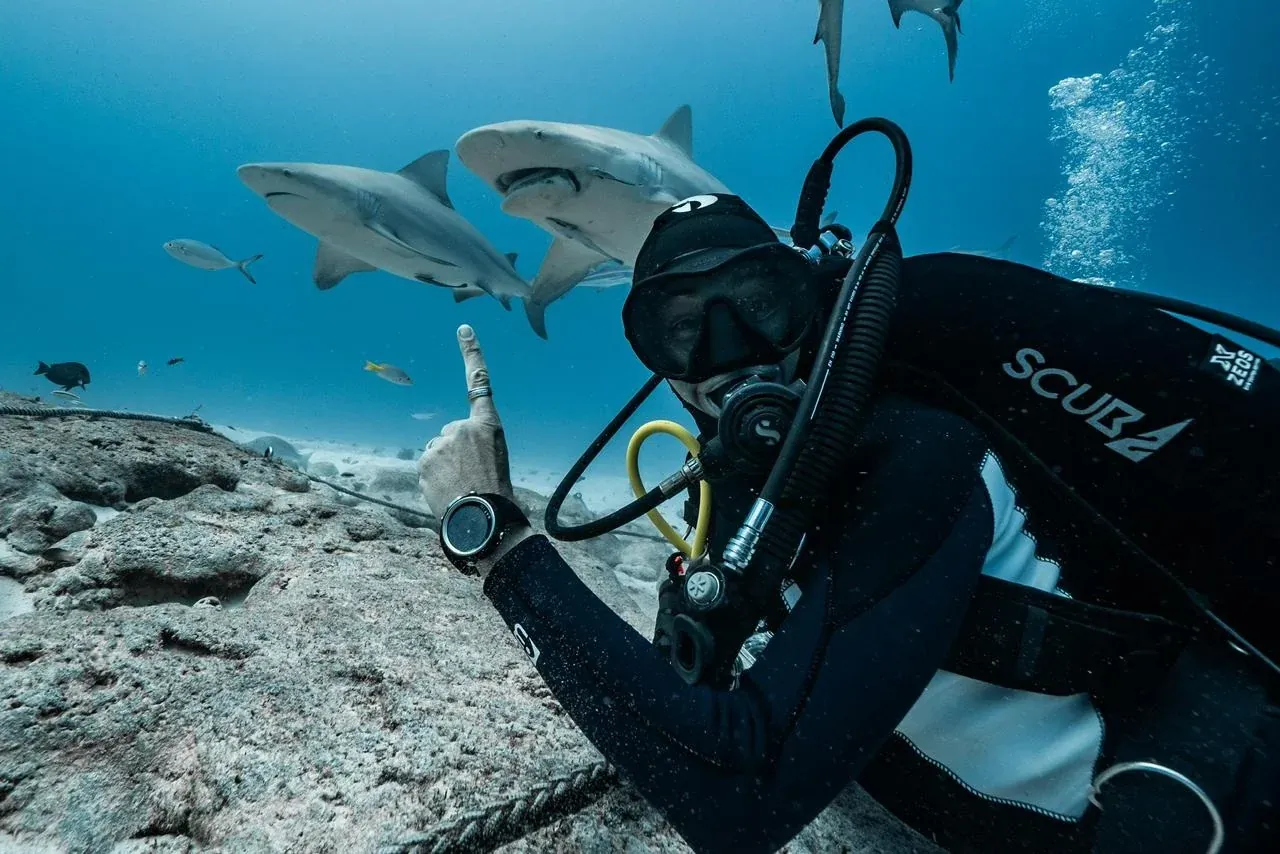
Diving with bull sharks in Playa del Carmen is one of the most intense experiences in diving. But like any activity involving wild animals, there is a right way to do it — and a wrong way.
The difference is not only ethical: it directly affects safety, the quality of the encounter and the continuity of an experience that depends on the animals choosing to return each season.
This guide explains what to do, what not to do and why each protocol exists. If you have already booked your bull shark dive, read it before getting in the water. If you are still planning, it will help you understand what distinguishes a responsible operator from one that is not.
Why bull sharks need us to treat them well
The pregnant female bull sharks that arrive each winter to the waters off Mamitas Beach are not there by chance. They return to the same spot year after year in a behaviour that scientists have been documenting for over two decades. This phenomenon is extraordinary and fragile at the same time.
When human behaviour in the water is respectful, the sharks maintain their natural patterns, continue choosing that spot for their reproductive period and the encounter can be repeated season after season. When there is repeated stress, the animals may modify their routes, shorten their presence or stop frequenting the area altogether.
The rules: what you can and cannot do
There is no specific national regulation for bull shark diving equivalent to the one that exists for whale sharks. However, responsible operators in Playa del Carmen apply a set of consensual norms that have proven their effectiveness over years.
- Remain static on the sandy bottom during the dive: do not actively swim towards the sharks.
- Do not intercept the path of the animals or place yourself between a shark and its direction of movement.
- Do not touch the sharks under any circumstances, not even briefly.
- Maintain neutral buoyancy at all times.
- Follow the instructions of the guide and feeder at all times.
The feeding dive: how it works correctly
In the feeding mode, a professional feeder introduces controlled food into the water to attract the sharks to the divers' area. When done correctly, the sharks approach in a natural and predictable way, divers remain static and the encounter is orderly and safe.
Responsible feeding does not involve provoking the animals or creating competition between them. The expert feeder knows how to manage quantity, rhythm and position to make the encounter flow smoothly. An operator that feeds irresponsibly — with excess food, without group control or provoking aggressive behaviour — is not doing their job well.
Passive observation: the encounter without interference
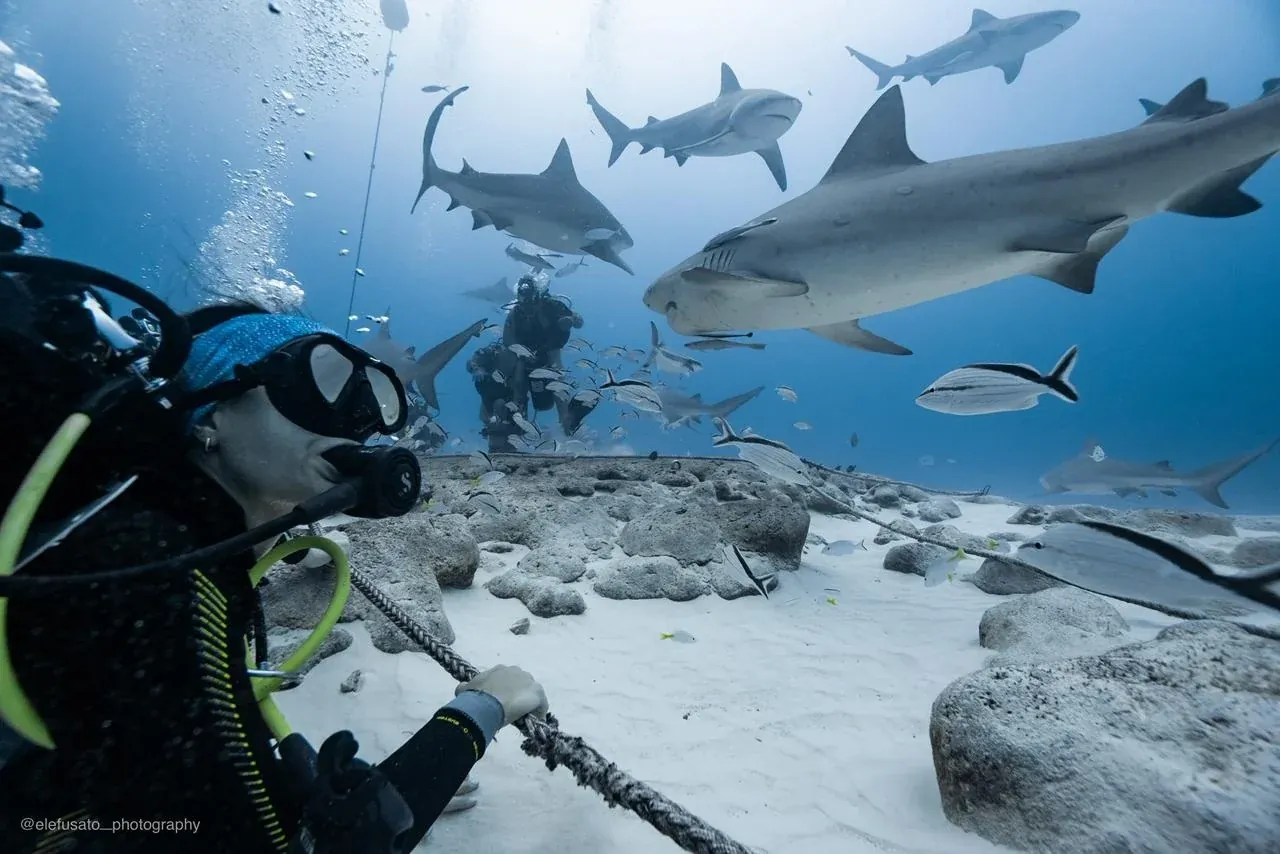
In passive observation mode there is no food and no feeder. Divers descend to depth and observe the sharks behaving in a completely natural way: patrolling, resting on the bottom, coming and going from the blue.
The animals tend to stay at greater distance than in the feeding mode, but the behaviour is natural and the atmosphere is calmer. It is the mode that most closely approaches the philosophy of pure nature tourism.
What to do on the day of the dive
The briefing you receive before entering the water is not a formality: it is the most important part of the experience. Any responsible operator must cover basic bull shark biology, water positioning, guide signals, what not to do and how to manage your equipment.
- Understand why the sharks are there and what behaviour they may show.
- Learn how to settle on the bottom and maintain position.
- Review guide signals before descending.
- Avoid sudden movements, rapid ascents, chasing the animals or attempting to touch them.
- Carry your computer, camera and regulators with no hanging elements.
During the dive: correct behaviour
Stay still on the bottom
The standard position for bull shark diving is sitting or kneeling on the sandy bottom, with neutral buoyancy, without moving. Sharks quickly become accustomed to static objects in their environment.
If a shark approaches directly
Stay completely still. The guide or feeder will manage the situation. In the vast majority of cases, the shark simply passes by or veers away before reaching you. Rapid movement can be more disruptive than staying still.
The camera: how to use it without causing disturbance
Bull shark diving offers extraordinary photographic opportunities, but the camera should never become the reason to compromise protocols. Do not get closer than permitted for a better shot. Do not use flash. Do not block the guide's view with your camera during critical moments.
How to choose a responsible operator
- A complete and detailed briefing before entering the water.
- Small groups: fewer divers means more space, more control and a better experience for everyone.
- A certified and experienced feeder, with dedicated safety divers.
- Honest communication: no responsible operator guarantees sightings of a specific number of sharks.
- Years of specific experience at this exact dive site.
At Scuba Alux, Mimi and the team have been conducting these dives for years with small groups, full safety support and a briefing that covers everything you need to know before entering the water.
More information about bull shark diving in Playa del Carmen.
Related articles
Your questions answered
Is bull shark diving dangerous?
The risk is minimal when dives are properly organised and protocols are followed. The Playa del Carmen encounter has been conducted for years with a very strong safety record.
Can you touch the sharks?
No. Under no circumstances. Touching a shark alters its behaviour, can trigger a defensive response and is harmful to the animal.
What should I do if a shark comes too close?
Stay completely still and let the guide or feeder manage the situation. In the vast majority of cases, the shark simply passes by.
What certification do I need?
Open Water Diver with experience may be enough, although Advanced or equivalent is recommended. Good buoyancy control and recent experience are the most important points.
Is feeding or passive observation better?
It depends on what you are looking for. Feeding offers closer interaction; passive observation is calmer and shows natural behaviour. Both can be responsible when done correctly.