Complete guide · Riviera Maya
What is Sargassum and How Does It Affect My Riviera Maya Diving Trip?
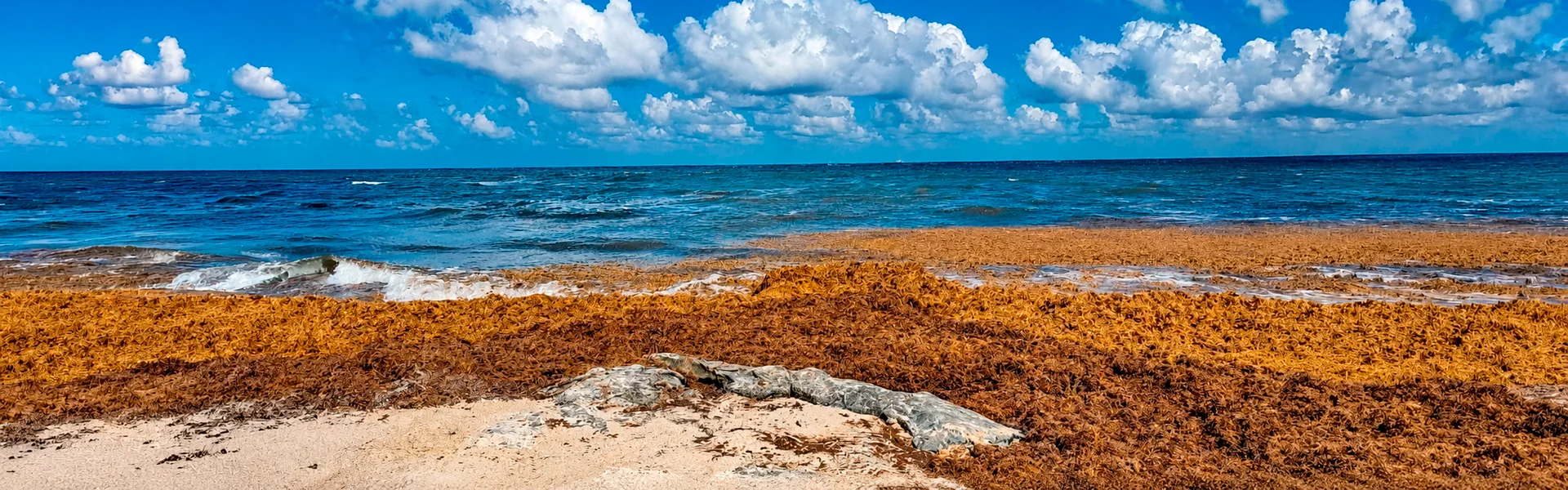
If you are planning a diving trip to Playa del Carmen or the Riviera Maya, you have probably heard about sargassum. Images of brown seaweed piling up on beaches can raise doubts about whether the trip is worthwhile, or whether diving will be affected.
In this article we explain what sargassum is, why it arrives on the Mexican Caribbean coast, how it actually affects different diving experiences and what options you have to make the most of your trip regardless of the time of year.
What is sargassum?
Sargassum is a type of brown marine algae of the genus Sargassum that floats on the sea surface. Under normal conditions it lives in the Atlantic Ocean, forming large floating masses that serve as habitat for many marine species. The problem arises when it arrives in large quantities on Caribbean shores.
Since around 2011, and especially since 2018, the mass arrival of sargassum on Mexican Caribbean beaches has become a recurring phenomenon. Scientists attribute this increase to climate change, rising water temperatures and increased nutrients in the Atlantic Ocean from agricultural activity in the Amazon and Congo River basins.
When does sargassum arrive in the Riviera Maya?
Sargassum does not have a fixed or predictable season. It can appear at any time of year, although historically the months of highest influx tend to be March to October, with frequent peaks between May and August. Quantities vary enormously from year to year and from week to week.
The key thing to understand is that sargassum is a surface phenomenon. What happens on the beach does not necessarily reflect what is happening underwater.
Does sargassum affect diving?
This is the most important question for any diver planning a trip to the Riviera Maya. The answer depends on the type of diving you have planned.
Cenote diving — Not affected
Cenotes are underground freshwater systems completely independent of the sea. Sargassum does not reach cenotes and does not alter their water, visibility or conditions in any way. Cenotes like Dos Ojos, El Pit, Angelita or Chac Mool work exactly the same during sargassum season as at any other time of year.
If sargassum is your main concern, cenotes are the perfect option: spectacular visibility, fresh water at 24-25°C year-round and completely stable conditions.
We have highlighted across several of our blogs that one of the main attractions of the area is precisely this: with the cenotes, diving is always guaranteed.
→ Everything about cenote diving from Playa del Carmen
Reef diving from Playa del Carmen — Limited impact
Sargassum floats on the surface. Once underwater, from about 2-3 metres depth, conditions are generally good. The main impact occurs during entry and exit from the water, and in reduced natural light when the surface is genuinely covered in algae. On boat dives, the guide chooses the sites in the best condition and entry is made directly from the boat.
Diving in Cozumel — Minimally affected
Cozumel, due to its geographic position and the channel currents, tends to be less affected by sargassum than the mainland beaches. It is one of the best reefs in the world and its diving conditions are exceptional practically year-round.
Most of Cozumel's dive sites are on the western side of the island, the opposite side to where the large sargassum arrivals occur. While this does not guarantee the complete absence of the algae, it does reduce its quantity substantially.
→ Everything about diving in Cozumel
Whale shark snorkelling — Not affected
Whale shark snorkelling takes place in the open sea off Isla Mujeres, far from the coast and from the areas where sargassum accumulates. The experience is not affected by beach sargassum: it is an oceanic excursion, not a coastal one, and conditions in that area are completely independent of what happens on the shoreline.
→ Everything about whale shark snorkelling
Tips for planning your trip
- Check with your dive centre before travelling. Sargassum arrivals cannot be predicted far in advance, but we can advise you on how the season is going and what alternative plans we have in case conditions were to affect the quality of any of the planned dives.
- Prioritise cenotes if sargassum is your main concern. They are completely unaffected by it.
- Do not cancel a trip based on social media images. The situation can change completely within a few days.
- Combine cenotes with reef diving. Even with sargassum on the coast, you can enjoy cenotes perfectly and do reef dives from a boat with minimal impact.
- Check local and recent sources before your trip. Local operators have the most up-to-date information.
Sargassum and the marine ecosystem
Sargassum, although inconvenient for tourism, is not intrinsically bad for the ecosystem. In the open sea, sargassum masses are important habitats for turtles, fish and other species. The problem arises when it reaches the coast in massive quantities, where its decomposition can affect coastal reefs and the quality of the beaches — which is undoubtedly another of the Riviera Maya's attractions.
Various local initiatives are working on solutions to make use of sargassum as fertiliser, construction material or biofuel.
Conclusion
Sargassum is a reality in the Riviera Maya worth bearing in mind, but it is not a reason to cancel a diving trip. Cenote diving is completely unaffected, reef diving has minimal impact and Cozumel maintains exceptional conditions practically year-round.
The key is to plan well, consult with local operators and be flexible. The Riviera Maya remains one of the world's best diving destinations, with or without sargassum.
Planning your diving trip to the Riviera Maya?
Tell us your dates and we will advise you on the real conditions and the best options for your trip.
We answer your questions
Is there sargassum all year round in Playa del Carmen?
Sargassum can appear at any time of year, although it is historically more common between March and October. Quantities vary enormously from week to week and are difficult to predict in advance.
Can I dive in cenotes even if there is sargassum?
Yes, without any problem. Cenotes are freshwater systems completely independent of the sea. Sargassum does not affect them at all.
Does sargassum affect underwater visibility?
Generally not. Sargassum floats on the surface and from about 2-3 metres depth conditions are usually good. The impact on visibility is generally minimal.
Is it dangerous to swim with sargassum?
It is not dangerous in itself. Decomposing sargassum can irritate skin and eyes with prolonged exposure, but it does not pose a health risk. This decomposition happens when large masses of sargassum reach the shore, not while the algae is floating in the water.
When is the best time to visit Playa del Carmen to avoid sargassum?
November to February tends to have less sargassum and coincides with bull shark season. However there are no guarantees, as sargassum can appear at any time. The best approach is to consult with local operators before your trip.
Ready to dive in the Riviera Maya?
With or without sargassum, diving is guaranteed. Contact Scuba Alux and we will put together the perfect plan.