Playa del Carmen Diving Guide
Diving in Playa del Carmen: Cenotes, Tiburones y Cozumel
Some diving destinations offer a good reef. Others have one special species or exceptional visibility. Playa del Carmen is different: within a two-hour radius, you can find three completely different underwater ecosystems, each one unlike anything you have seen before. That is what makes diving in Playa del Carmen one of the most complete diving destinations on the planet.
Why Playa del Carmen is a top-level diving destination
The Riviera Maya has a unique place on the world diving map. Under Playa del Carmen and the surrounding area lies the largest underground river system in the world, bordered by the second largest coral reef system on the planet. On top of that, every winter large bull sharks arrive off the coast of Playa del Carmen, and every summer the region receives large aggregations of whale sharks.
Water conditions and visibility
Caribbean waters stay between 26 °C and 30 °C year-round. Open-water visibility usually ranges from 20 to 40 meters; in the cenotes, thanks to the purity of the freshwater and the lack of sediment, it can exceed 60 meters. These conditions make diving, photography and enjoyment much easier.
Easy access and simple logistics
From Fifth Avenue, you can reach the main cenotes in 30–45 minutes, the Cozumel ferry in 10 minutes and the bull shark dive sites directly from the coast. There is no need to rent a car or plan complicated transfers. Everything is connected.
Cenote diving: the oldest underwater world on Earth
If you had to choose just one underwater experience in your life, many divers would tell you to choose a cenote. It is not an exaggeration.
What is a cenote and why is it so special for diving?
Cenotes are natural freshwater sinkholes formed thousands of years ago when the roofs of limestone caves in the Yucatan Peninsula collapsed. What remains are underground limestone cathedrals with beautiful formations such as stalactites and stalagmites, filled with incredibly clear water. Sunlight enters through the openings and creates beams that cut through the water with a precision no photographer could recreate artificially. Diving in a cenote feels like moving inside a photograph.
The most remarkable cenotes near Playa del Carmen
- Dos Ojos — One of the most accessible cenotes for divers of all levels. Its two connected entrances allow cavern dives without a cave diving certification.
- Angelita — Famous for its hydrogen sulfide layer at around 30 meters, creating a “submerged river” effect with trees emerging from the mist.
- Casa Cenote — A mangrove cenote where freshwater mixes with Caribbean saltwater, creating remarkable biodiversity.
- Dream Gate — A favorite among local guides for its geological formations and quieter atmosphere.
- El Pit — More than 120 meters deep, it is one of the deepest cenotes in the world. Below 30 meters, a sulfur cloud creates a unique atmosphere. Recommended for Advanced divers or above.
What level do you need to dive in cenotes?
For some cavern-type or open sinkhole cenotes, an Open Water Diver certification is enough. Others require Advanced certification.
For caves, specific technical diving certification is required. At Scuba Alux, we advise you on which cenote best matches your level before organizing the trip.
Diving in Cozumel: the Caribbean’s most famous coral reef
Just 45 minutes by ferry from Playa del Carmen, Cozumel is home to one of the most spectacular and best-preserved coral reefs in the world. Jacques Cousteau visited it in the 1960s and placed it among the best diving destinations on the planet. More than 60 years later, that still feels true.
What to see underwater in Cozumel
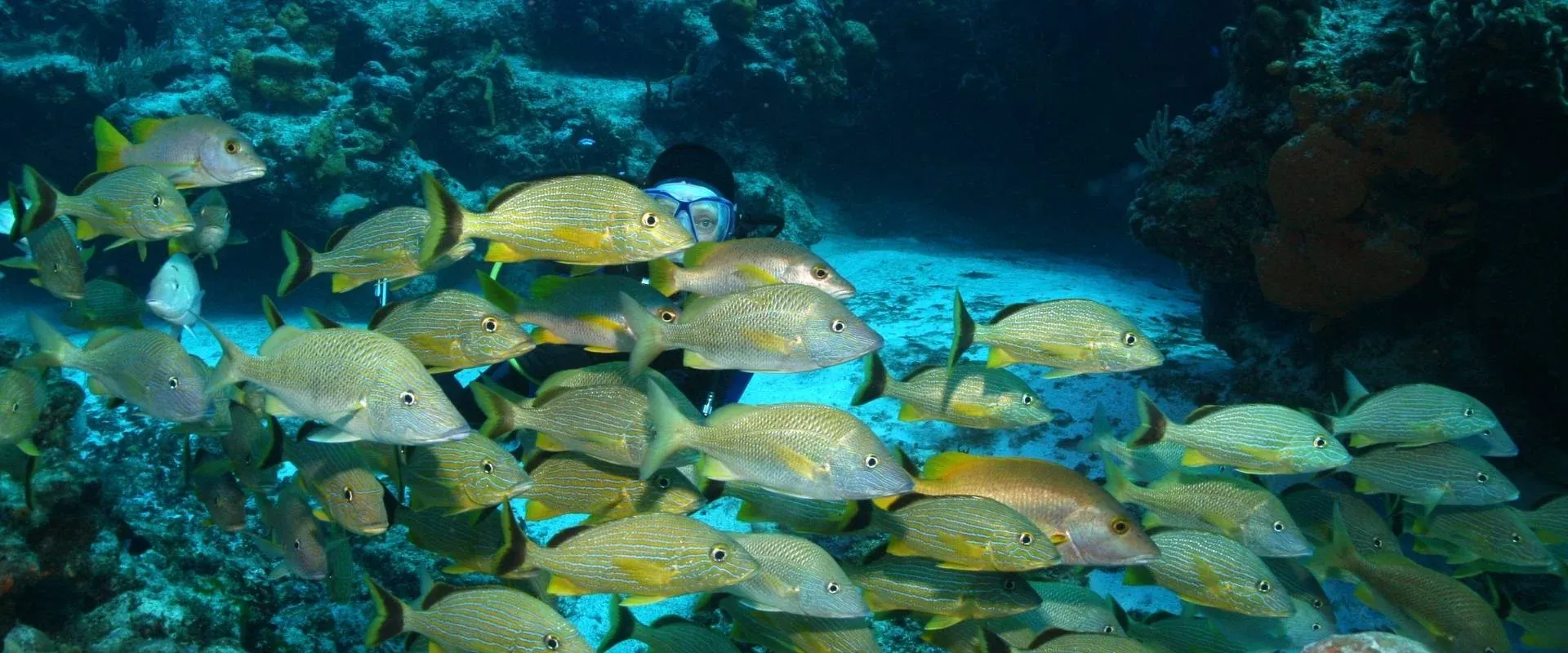
Vertical black coral walls, huge sea fans, turtles calmly swimming past divers, schools of butterflyfish… The biodiversity of the Mesoamerican Reef in Cozumel is hard to describe. The current makes drift diving easy, allowing you to float over the reef almost effortlessly.
How the trip from Playa del Carmen is organized
Some local dive centers, including Scuba Alux, organize Cozumel trips by direct boat from Playa del Carmen. Other centers only offer the option to cross by ferry and dive from the island. Two dives are usually done on different reef sites on the same day.
Bull sharks in Playa del Carmen: Mexico’s most exciting dive
Between November and March, the waters off Playa del Carmen become one of the few places in the world where you can dive regularly with bull sharks (Carcharhinus leucas). Not occasionally, not by chance: almost guaranteed during the season.
When and why do they gather here?
The phenomenon has a biological explanation: pregnant female bull sharks come to these waters because the cenotes of the Riviera Maya enrich the sea with minerals and nutrients that support their reproductive cycle. Year after year, dozens of females return to the same area.
The dives are done at around 23 meters deep, usually with good visibility and moderate to strong current. Two options are available: a feeder dive and a passive observation dive focused on respectful wildlife observation.
Is it dangerous to dive with bull sharks?
The bull shark has a reputation as one of the more powerful shark species. In this specific context, however, the reality is different: the dives are guided by professionals with years of experience in this environment, with established safety protocols and a clear understanding of animal behavior. The risk is very low when the dive is done correctly.
Practical information for planning your Riviera Maya diving trip
Best season to dive
| Experience | Best season | Notes |
|---|---|---|
| Cenotes | Year-round | Constant temperature around 25 °C, with little dependence on weather |
| Cozumel | Year-round | Best visibility from December to May |
| Bull sharks | November – March | Peak season in January and February |
| Whale shark | May – September | Snorkeling experience, not scuba diving |
Recommended levels by experience
- No certification: Discover Scuba Diving in the ocean or at Casa Cenote. From 10 years old.
- Open Water Diver: Access to the main experiences — Cozumel, cavern cenotes and bull sharks.
- Advanced Open Water: greater depth in Cozumel and access to cenotes with more complex profiles.
- Technical cave certification: cave diving.
Why choose Scuba Alux for your underwater adventure
There are several dive centers in Playa del Carmen. Not all of them work the same way.
Scuba Alux is intentionally small. Mimi, its founder and lead instructor, works with small groups to make sure every diver receives individual attention. That sometimes means saying no when a group is full. Underwater, that decision matters: more time to help, more time to wait and more time to notice details that are easy to miss in a large group.
The equipment is constantly maintained. Transfers are punctual. And if you are unsure about your level, which cenote suits you or whether bull sharks are right for you, Mimi answers before you book, not after.
The 141 five-star Google reviews are the result of that approach.
Planning a trip to Playa del Carmen?
Write to us on WhatsApp or through the contact form. We will help you design the diving days that best fit your level, dates and expectations.
Still have questions?
We answer the most common questions about each type of diving experience. Check the FAQ section for the activity you are most interested in:
- Cenote diving FAQ — levels, water temperature, which cenote to choose and how many dives per day.
- Cozumel diving FAQ — differences with Playa del Carmen, ferry vs speedboat and night dives.
- Playa del Carmen diving FAQ — currents, reefs and sea conditions.
- See all Scuba Alux FAQs — the complete FAQ page with all topics separated by category.
Ready for your next dive?
Contact us and we’ll help you plan the perfect diving experience for your level and goals.